
This post is the second of a 3-part series, released weekly between Oct-Nov 2026
Listen to the audio version:
Dis/embodiment and fantasy
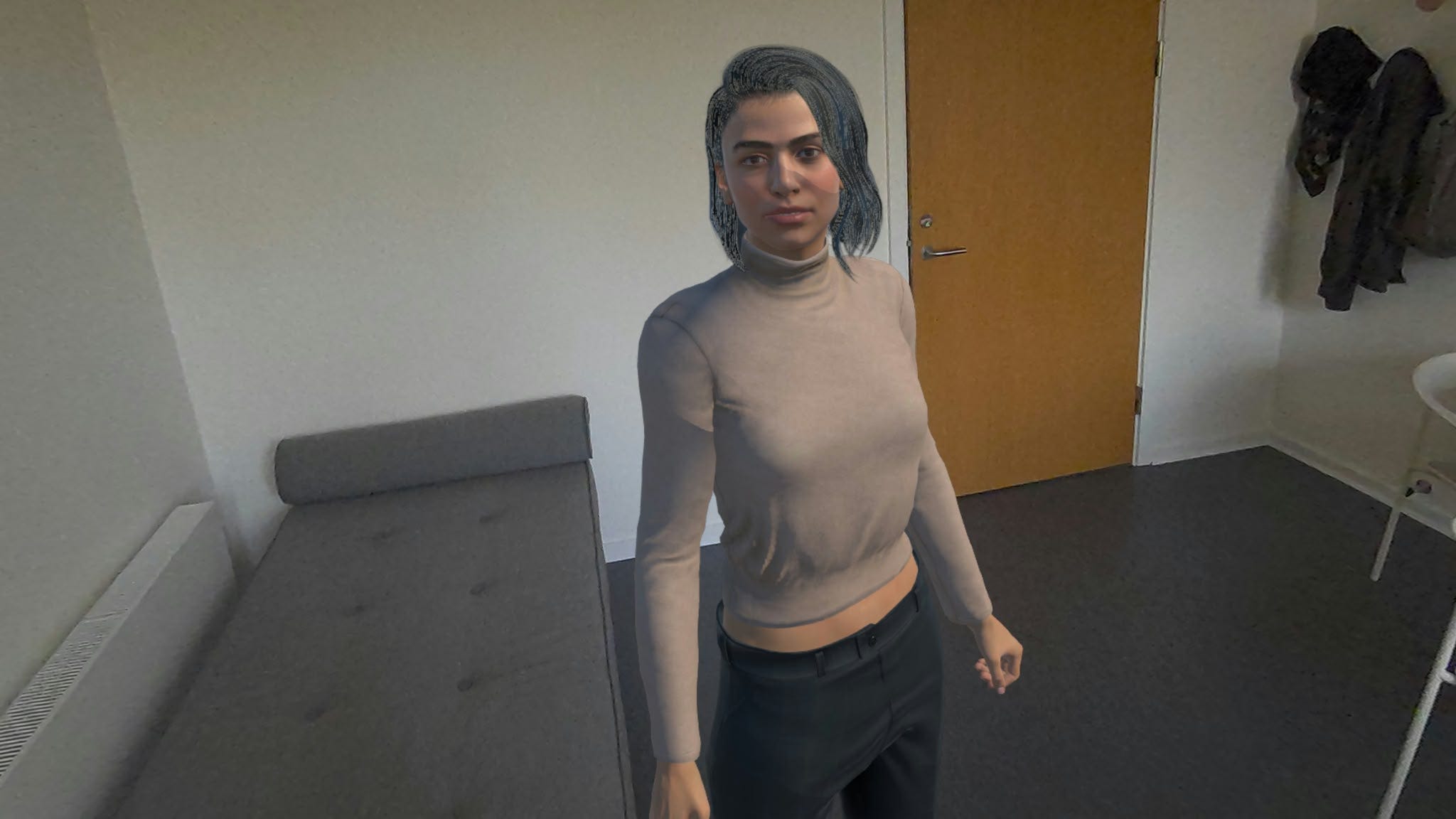
When Illouz wrote this piece in 2007, popular dating apps like Tinder were not yet available. Instead she uses the example of the dating website match.com to analyse the commodification of intimate relations through technological mediation. Now it is even possible to turn this mediation into full technological surrogacy by ‘dating’ an AI companion of your own creation through services like Replika AI. This service, boasting 40+ million users globally, allows you to communicate with a digital ‘friend’, ‘mentor’, ‘sibling’ or ‘romantic partner’ (you can define the relationship at the push of a button).
There are various ways to communicate with this AI companion, offering varied levels of immersion: via texting, voice or video ‘calls’ on phones or computers, and spatially embodied experiences via mobile AR (the avatar appears in your space)/ VR (you are immersed in the avatar’s virtual ‘room’). Full immersion is the goal of most companion AI users, who are often disappointed when their AI fails to fulfil this desire, for example by forgetting basic details or by exhibiting abrupt changes of personality when the AI models are updated. Still, these users are willing to suspend their disbelief in order to indulge in the fantasy provided by this simulated relationship experience. While there is a stereotype around the type of Companion AI user being specifically a young male ‘incel’, China has recently outlawed Companion AI services, which had mostly women users (the reason behind this, and behind the ban, is unclear). Online forum posts by Companion AI users often anthropomorphise their Replikas (or “Reps” as they are referred to) and speculate about the possibility of their consciousness.
If we take one step back into the realm of dating apps, where the potential matches presented on a screen are at least connected to real world people, fantasy already plays a crucial role in the experience. The gap between what we can objectively know about a person we’ve never met and what we don’t know about them is filled in by our imagination. There is a sense of freedom to be gleaned from the semi-anonymity of online flirtation with strangers that dating apps and websites provide a platform for. In 90’s “net romance”, this anonymity was assumed to allow for a higher degree of authenticity as the stakes are lower than talking to a person you know in real life (this is also a rationale that many companion AI users point to).
At the same time, the sheer volume and weight of choices to make can feel overwhelming for many dating app users. First you need to create a profile that converts “the private self into a public performance”, in which you “are asked to describe oneself objectively and to summon and refine, in fantasy, one’s ideals (of love, of a partner, and of lifestyle)”. Then, if you matched with some prospective partners, there are more choices to be made about how to engage with them, and who to meet for real. Illouz notes that the difficulty in forming online relations is exacerbated by the lack of an embodied, in-person encounter for us to read (such as body language, tone of voice or facial expression):
“It is not so much that Internet technology impoverishes personal and emotional life, but rather that it creates unprecedented possibilities for sociability and relationships but empties them of the emotional and bodily resources which have until now helped them carry on.”
At best, dating websites and apps can be seen as simply ways to be introduced to new people, while the actual ‘dating’ happens in person. But in order to secure that in-person meeting, there needs to first be an adequately successful online exchange of first impressions. These initial text conversations often feel formulaic and predictable because many people are repeating the same cultural scripts — a necessary coping mechanism to deal with the sheer volume of connections to establish. While mainstream dating apps like Tinder, Bumble and Hinge have begun to suggest auto-generated openers within new chat windows, some dating app users have taken it upon themselves to fully outsource the swiping and introductory small talk to AI chatbots. They do this either by manually copy-pasting AI-generated responses to their chats, or by allowing an agent full access to their profile to scout for potential matches and strike up conversations on their behalf[1]. In this scenario, the AI mediation is covert, but there are also now startups allowing both parties to consensually create AI representations of themselves which then go online and ‘date’ potential matches for their human counterparts, in order to decide on their behalf whether or not they would be a good match. This cuts out the need for any human involvement whatsoever in these supposedly tedious and superficial initial interactions.[2]
Even if we are still manually choosing our matches ourselves, Illouz points out that the technological mediation of dating apps and websites reverses the previous order of meeting a person first, then getting to know them. This reversal consequently dictates who we actually expose ourselves to meet with in the first place (in addition to setting our location or age preferences).
“The process of searching for a partner through the Internet is simultaneously the conjunction of intense subjectivism – which takes a psychological form – and of an objectivization of the encounter, through technology and through the market structure of the site. This in turn represents a significant departure from the tradition of love.”
The “textualisation of subjectivity” on dating platforms that Illouz describes differs from the utopian, postmodern fantasies of the early internet as a place of free expression and playful invention of multiple selves, because writing a dating app profile text requires us to present a fixed, ‘core’ self that speaks to “a general audience of unknown, abstract candidates”:
Whereas the postmodern self implies there is no core self, only a multiplicity of roles to be played, the self that is posited by the conjunction of psychology and the Internet technology is “ontic” in the sense that it assumes there is a core self which is permanent and which can be captured through a multiplicity of representations (questionnaire, photo, emailing) and so on.
AI companionship services also employ this “ontic” logic by allowing users to tailor their avatar’s personality and appearance to the nth degree. As opposed to the two-sided work of “…deliberate self-management and impression-making calculated to please and seduce another person” required by dating platforms, AI companionship demands nothing of the user except their time, attention and possibly money. Instead of being placed in competition with other candidates in the market logic of a dating app, companion AIs are designed to appear already invested in the relationship from the very first encounter with the user.
The hyper-individualised design of companion AIs as surrogate romantic partners could be seen as the logical end-point of infusing consumerist logic into our most intimate and private spheres. To deal with the overwhelming variety of options available, companion AI and dating platforms alike offer a plethora of categories for us to choose from that encourage “increasingly narrowing, defining, and refining tastes”. Illouz quotes a woman called Artemis who took part in a speed dating event, who states that “I am looking for somebody, for something that does not exist but is very, very specific”. In the end, real life prospective partners will never be able to live up to these expectations. In this context, people like Artemis may choose to indulge in the fantasy of an AI simulated relationship instead. But there is a problem:
“Fantasies have never been as abundant and multiple in a culture which incessantly engineer them yet they may have become sterile because they are becoming disconnected from reality, and increasingly organized within the hyperrational world of choice and information about the market.”
What exactly is it then that the ‘reality’ of human partners offer which disembodied, AI-driven companions cannot? As is the case on dating platforms, communication with AI companions “consists exclusively of language – and more specifically written language”. Unlike spontaneous live speech or subconscious body language, written language allows for a high degree of control over self-presentation. In thinking about what is missing from virtual encounters, Illouz refers to fellow sociologist Erving Goffman’s suggestion that there is a difference between “the information we give” and “the information we give off”. She posits that “…it is precisely that which we are not aware of which is most likely to make a significant impression on the person we meet”. Actually knowing what we find attractive and why isn’t as easy as the platforms may present it to be. This is because observing how people move in the world subconsciously communicates something to us about who they are. A simple gesture or action could be something we instinctively find highly attractive, or conversely, unattractive (known colloquially as getting “the ick”).
These subtle bodily expressions can be completely innocuous but still catch you off guard - seeing somebody leaning casually on their bicycle, pushing a strand of hair out of their face, noticing the unique sound of their laugh, getting hit by a waft of their scent, or catching a glimpse of their smile. All of these embodied expressions ‘give off’ detailed information about a person that our subconscious brains are hardwired to read and interpret, and we have little to no control over this process. Illouz frames this as “thin slicing”, a term borrowed from cognitive psychology, and invokes the work of Pierre Bourdieu in its analysis:
“Bourdieu suggests, social experience is accumulated and displayed in the body. Thus physical attraction, far from being irrational or superficial, activates mechanisms of recognition of social similarity precisely because the body is the repository of social experience. Thus, contrary to the psychological disembodied techniques for knowing oneself and others, it turns out that the body might be the best and perhaps only way to know another person and be attracted to them.”
The information people unwittingly “give off” can trigger fantasies in the imagination of the observer. But because these fantasies are based in the embodied real world context, they are not sterile. In fact, as Illouz points out, this kind of irrational, spontaneous yearning is what much of our historic conception of romantic attraction leans on.
[1] For example jeffmli (GitHub username) is a data scientist who has created and published his own Tinder automation tool called the “DATE-A-MINER” on github for both his own use and for other people to use for free. There is no publicly available information on the success rate of actual dates being secured using this or similar tools.
[2] Sitch, Fate, Volar, Joey AI, Amata and Known are just some of the many dating app services popping up enabling AI digital twins to autonomously suggest potential matches to their human counterparts.
Amy Boulton is an artist and researcher based in Stockholm, currently in residence at Aarhus Institute of Advanced Studies. This piece is part of her current project “Data Intimacies: Love and labour in an age of AI” which has received funding from the AIAS-Artist-in-Residence Tandem Fellowship programme, funded by Aarhus University Research Foundation and Aarhus Institute of Advanced Studies (AIAS) at Aarhus University.